KwaZulu‑Natal’s coastal humidity and high rainfall make parapet and balcony waterproofing details unforgiving. Durban averages roughly ~1,009 mm rain per year according to the SA Weather Service figure quoted by IOL.
Extreme events raise the stakes. During the 11–12 April 2022 Durban flood event, some stations recorded two‑day totals as high as 515 mm, with area‑averaged rainfall around 137 mm across the larger Durban region.
In this article we explain in practical building terms why flat roofs and balconies leak at parapets, how rising damp and trapped moisture show up, why torch‑on systems fail, and how to avoid the patch‑repair cycle.
Why KZN roofs leak more often
Flat roofs and balconies fail more often at edges and changes in direction than on open flat areas. In KZN (especially Durban and the North Coast/South Coast), you typically have:
- Wind‑driven rain pushing water sideways into small gaps.
- High humidity slowing dry‑out once moisture gets into a wall or screed.
- Thermal movement (hot sun → cool rain) stressing joints and upstands.
- Salt air near the coast accelerating corrosion on caps, fixings, and flashings.
Parapets concentrate all of these forces into a small zone.
Where parapet leaks usually start
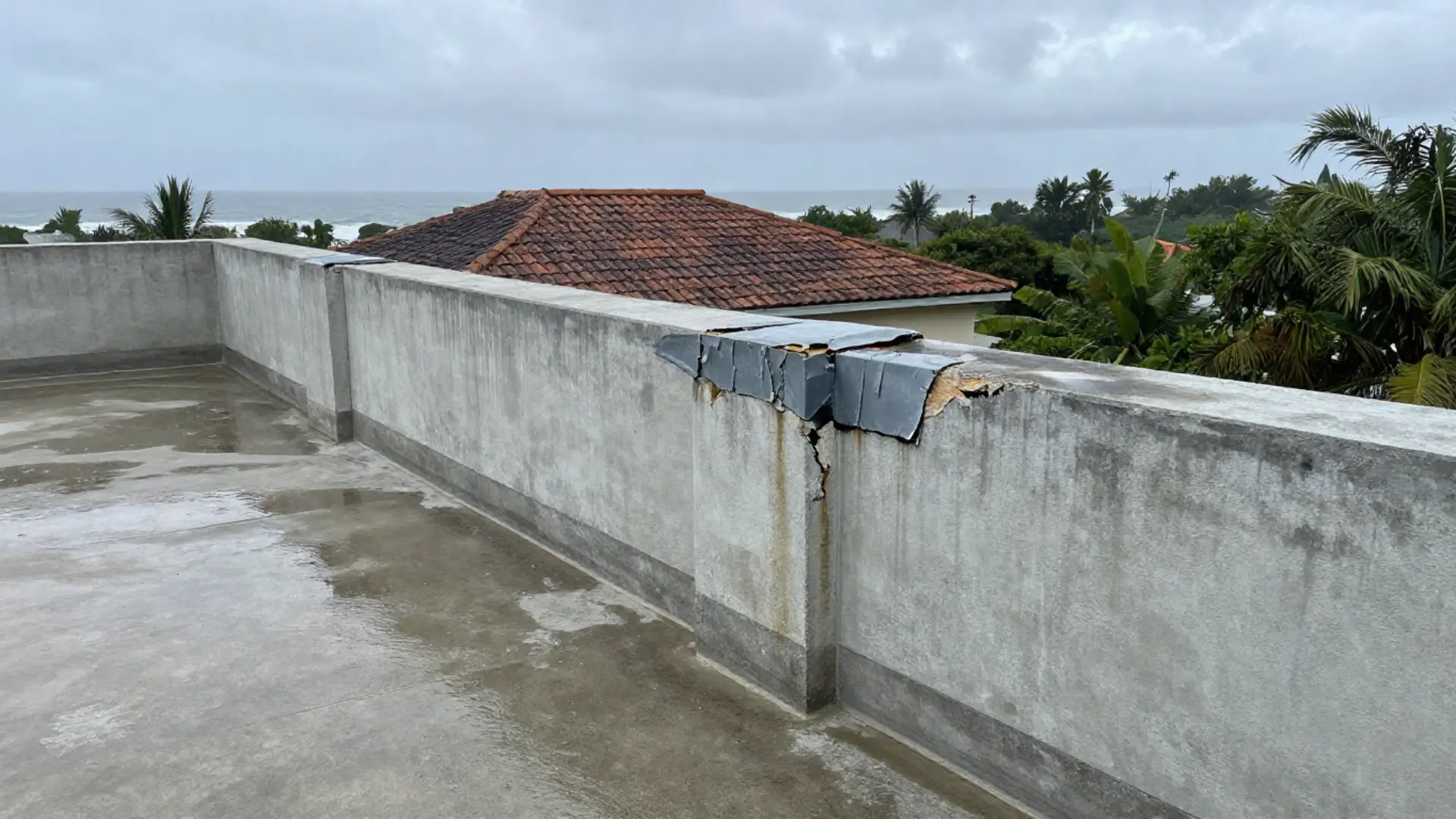
A parapet is essentially a short wall at the edge of a roof or balcony. The waterproofing must turn up the wall (upstand), transition across the top, and shed water away from the building.
Common failure patterns in KZN builds:
- Waterproofing turns up the parapet but is too low, then gets overtopped in heavy rain.
- The parapet cap is decorative, not weatherproof, or has no drip edge.
- Cracks form at movement/expansion joints and are “painted over”.
- The roof has poor falls and develops ponding (standing water), increasing time‑under‑water and forcing water into weak points.
Parapet caps: the top edge that stops (or starts) leaks
If water can enter at the top of the parapet, it can travel down inside the wall and show up as:
- Bubbling paint and salt marks.
- Damp patches inside rooms below.
- Blown plaster at skirtings (often blamed on “rising damp”, even when it’s actually water ingress from above or from the side).
What a good parapet cap should do:
- Be fully weathered and fixed to prevent uplift.
- Have a drip edge on both sides so water breaks free and does not run back under the cap.
- Avoid puncturing the waterproofing in high‑risk zones.
Specific to KZN: salty air and humidity mean small cap gaps don’t “dry out” quickly. They stay wet longer, which accelerates deterioration.
Upstands: the weak spot most people miss
Torch‑on membranes often fail at parapets because installers treat upstands like an afterthought.
Typical torch‑on upstand failures:
- Insufficient height: the membrane doesn’t run high enough up the parapet.
- Poor detailing at corners: corners are cut, folded, or patched without proper reinforcement.
- Incompatible coatings/paint: coatings that don’t protect against UV or don’t bond properly.
- Capillary tracking: water gets behind laps and travels.
Practical rule: if an upstand is low, poorly bonded, or unprotected, KZN rain will find it.
Drip edges: small detail, big difference
A drip edge is a small projection or formed edge that forces water to drip off cleanly.
Without drip edges:
- Water clings to the underside (surface tension), runs back to the wall, and soaks the parapet.
- Paint and plaster fail repeatedly.
- The problem masquerades as rising damp.
On balconies, drip edges matter even more because water can run under tiles, into screeds, and into slab edges.
Expansion joints: buildings move so your waterproofing must too
Concrete and masonry move.
- In KZN you often have daily cycles of hot sun and sudden rain.
When expansion joints are missing or incorrectly sealed:
- Torch‑on splits at the joint.
- Sealants tear.
- Water enters and spreads laterally under the membrane.
The patch‑trap: a small crack is sealed on the surface, but the membrane underneath is already separated or waterlogged. The leak returns at the next heavy rain.
Ponding water: why ‘just a little’ standing water is a problem
Ponding increases:
- The time water has to penetrate laps.
- Hydrostatic pressure at weak points.
- Biological growth and surface degradation.
South African roof regulations specify minimum falls on flat roofs. SANS 10400‑L states finished falls should be at least 1:80 where flow is uninterrupted and 1:50 where there is interruption in the flow. (See section 4.3.1.1 in the standard PDF excerpt.)
KZN reality: blocked outlets after storms (leaves, silt, debris) turn marginal falls into ponding very quickly.
Why quick patches don’t last (and what to do instead)
Patch repairs often fail because they address the symptom, not the system:
A leak at the ceiling is patched, but the real entry point is the parapet cap.
A torch‑on split is overcoated, but the substrate is damp and the bond fails.
A balcony tile crack is sealed, but water is travelling under the tiles to the slab edge.
Signs you’re in the patch cycle:
- The leak moves location after each repair.
- You see damp after wind‑driven rain, not after light rain.
- The same area fails every season (especially during KZN summer storms).
Quick checklist before you approve any repair
Use this when assessing a roof/balcony or reviewing a waterproofing quote:
Parapet cap
- Proper weathering and fixings
- Drip edges both sides
- No “flat cap” that holds water
Upstands
- Adequate height and corner reinforcement
- Protected from UV and compatible with the system
Drip edges / terminations
- Defined edge breaks (no water tracking back)
- Proper termination bars/flashings where applicable
Expansion joints
Identified and treated with the correct joint system (not paint)
Drainage
- Confirm falls and clear outlets
- Overflow path considered (what happens if the outlet blocks?)
A typical KZN example: “rising damp” that wasn’t
A Durban townhouse balcony showed “rising damp” marks at the internal wall and peeling paint.
What was actually happening:
- The parapet cap had no drip edge and allowed water entry at the top.
- Balcony waterproofing had a low upstand with weak corner detailing.
- Ponding occurred during heavy storms, holding water against the parapet.
Correct repair (the one that lasts) required:
- Reworking the parapet cap detail (including drip edges).
- Reinstating proper upstands and corner reinforcement.
- Fixing falls/drainage so water couldn’t stand against the parapet.
Why homeowners choose Elite Roofing and Waterproofing
The fixes that last are detail-driven: correct parapet caps, proper upstands, reliable terminations, movement detailing, and drainage that prevents ponding. That work needs experience, not guesswork.
Elite Roofing and Waterproofing is the right choice because:
- 30+ years’ industry experience: we’ve seen the common failure patterns on KZN coastal builds, and we know where “quick fixes” typically fail.
- Root-cause approach: we trace leaks to the entry point (often parapet tops, corners, terminations, and joints), not just the damp mark inside.
- Detail-first workmanship: we focus on parapet capping, drip edges, upstand heights, corner reinforcement, and expansion-joint detailing to stop repeat failures.
- Drainage and falls matter: we assess ponding risk and outlet performance so water can’t sit and force its way into weak points.
- Clear scope and expectations: you get a practical plan that avoids the patch-repair cycle and reduces long-term cost.
A quick takeaway
In KwaZulu‑Natal, parapet and balcony waterproofing failures are rarely “mystery damp”. They’re usually predictable detail issues: caps, upstands, drip edges, joints, and drainage. If you fix the details, you stop the leak. If you keep patching the surface, you keep paying for the same problem.
If you’re in KwaZulu‑Natal and you’re dealing with a leaking flat roof, balcony, or parapet damp, contact Elite Roofing and Waterproofing for an assessment and a repair plan that fixes the detail, not just the symptom.